
War, Global Tension & the Small Business Advantage: Why Entrepreneurs Who Think Clearly Will Win This Decade
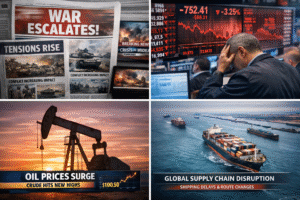
The world feels unstable.
War headlines dominate news cycles. Trade routes are strained. Oil prices fluctuate. Markets react instantly to geopolitical escalation. Governments are increasing defense budgets. Cyber threats are rising. Supply chains are recalibrating — again.
For the average person, this creates fear.
For a small business owner, this creates a decision point.
Will you operate from anxiety…
Or from strategic awareness?
The Real Economic Impact of War on Small Business
When geopolitical tensions escalate, small businesses feel it in four immediate ways:
1. Cost Volatility
Fuel, raw materials, insurance, financing — prices fluctuate. That pressure hits margins.
2. Supply Chain Instability
Shipping routes shift. Delivery times stretch. Inventory planning becomes strategic instead of routine.
3. Consumer Psychology
Uncertainty tightens spending. People delay decisions. Emotional buying drops. Practical buying rises.
4. Capital Reallocation
Governments redirect funding toward defense, cybersecurity, AI, infrastructure, and strategic industries.
Notice something important:
Money does not disappear during conflict.
It reallocates.
If you do not track where it reallocates, you operate blindly.
The Dangerous Trap: Survival Mode
Survival mode looks like:
- Cutting marketing entirely
- Avoiding investment
- Waiting for “things to calm down”
- Operating emotionally instead of analytically
But history shows something different.
After every major global conflict or economic shock:
- New industries surge
- Technology accelerates
- Wealth transfers
- Market leaders shift
The entrepreneurs who grew during instability were not reckless.
They were positioned.
The Entrepreneurial Mindset: Thrive Over Survive
Thriving does not mean ignoring risk.
It means:
- Reading macro trends
- Watching capital movement
- Adjusting strategy quickly
- Strengthening operations
This is not about optimism.
It’s about discipline.
Where Small Businesses Can Make Money Right Now
1. Stability Services
In uncertain times, clarity sells.
Businesses and individuals seek:
- Financial strategy
- Operational efficiency
- Risk management
- Cybersecurity
- Compliance guidance
- Business restructuring
If you provide structure, you become valuable.
2. AI & Automation Adoption
Periods of instability accelerate technology adoption.
Companies want:
- Cost reduction
- Workforce efficiency
- Automation
- Data protection
- Predictive analytics
Small businesses that integrate AI and offer tech-enabled services are not replacing people — they are expanding capacity.
AI is not a trend right now. It is a cost-control and risk-mitigation tool.
3. Strategic Pivoting
Ask this question:
What new problems does instability create?
Examples:
- Supply chain consulting
- Domestic sourcing alternatives
- Cyber risk assessments
- Remote workforce infrastructure
- Crisis communication services
- Mental resilience training
Every crisis creates new demand.
4. Government & Institutional Contracts
Conflict increases:
- Defense spending
- Infrastructure investment
- Security contracts
- Strategic technology funding
Small businesses with certifications (MWBE, federal registration, procurement readiness) position themselves for capital that is expanding — not shrinking.
Most entrepreneurs ignore this lane.
That is why it is profitable.
The Psychological Edge
The greatest shift during unstable periods is not economic.
It is psychological.
Fear contracts thinking.
Leaders expand perspective.
Your clients, your team, your audience — they read your posture.
If you panic, confidence erodes.
If you communicate strategy, trust strengthens.
In uncertain environments, leadership becomes marketable.
A Hard Question for Entrepreneurs
If global instability lasts three years, not three months — what changes in your strategy?
Do you:
- Diversify revenue streams?
- Build recurring income?
- Increase digital assets?
- Reduce dependency on single suppliers?
- Strengthen brand authority?
Or do you wait?
Waiting is a strategy.
It’s just rarely the profitable one.
The Hidden Opportunity
Major global shifts historically produced:
- Post-war manufacturing booms
- Technology revolutions
- Energy sector shifts
- Cybersecurity industries
- AI acceleration
This decade will be defined by:
- AI integration
- Security infrastructure
- Digital transformation
- Strategic alliances
The question is not whether change is happening.
It is whether you are positioning before it stabilizes.
Because once stability returns, the new leaders are already chosen.
Final Thought: This Is a Leadership Test
Small business owners are not just operators.
They are economic stabilizers in their communities.
This moment will reward:
- Clear thinkers
- Data-driven decision makers
- Adaptive leaders
- Bold but calculated action
You do not control global conflict.
But you control:
- Your mindset
- Your positioning
- Your partnerships
- Your innovation
Thriving is not accidental.
It is strategic.
And history consistently favors the entrepreneur who studies disruption instead of fearing it.